

The Most Expensive Lesson We Keep Refusing to Learn
A history of betting on machines and overlooking the people in the room

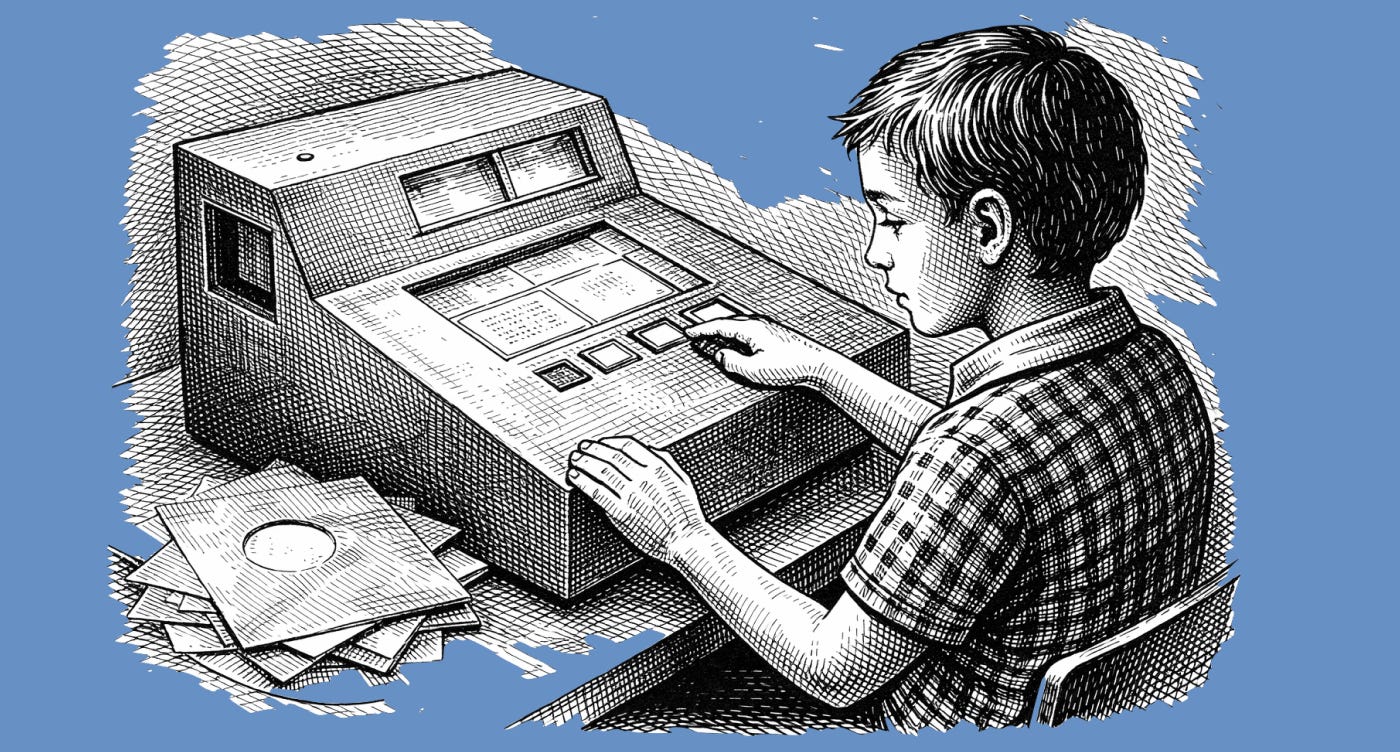
A student is issued a personal identification card. They use it to log in to a machine that knows who they are and where they stand in the curriculum. The machine delivers personalized questions calibrated to their current level. Answer correctly, and you advance. Answer incorrectly, and the system branches, routing you to a remedial question designed to address the specific gap before moving you forward.
Every student progresses at their own pace. The machine adapts. The teacher is freed from rote delivery to serve as a mentor and guide.
This is not a pitch from the early 2010s. It is a vision published in 1957 by Dr. Simon Ramo, a Cold War weapons engineer best known as the father of the intercontinental ballistic missile, in a paper called “A New Technique of Education.” The student’s ID card was called a “charga-plate.” The machine was a console with push buttons. And for a brief, strange window in American history, this was the future of school.
The push-button school was a product of Sputnik and the panic it created. When the Soviet Union put a satellite in orbit on October 4, 1957, the United States concluded that its classrooms were failing. Congress responded with the National Defense Education Act of 1958, which funneled federal dollars specifically into technological innovation in schools. A market opened overnight. Psychologists and engineers promised to turn education from an art into a science.
The theoretical backbone came from B.F. Skinner, who broke subjects into tiny incremental frames, steps so small that students were almost certain to answer correctly, with each correct response acting as a reinforcer. His rival Norman Crowder had a different philosophy. Errors were not to be avoided but diagnosed. His machine, the AutoTutor, branched incorrect answers into remedial explanations before routing the student back. Two competing approaches, but the same underlying premise: a machine could deliver personalized instruction more efficiently than a teacher standing in front of thirty students.
By the early 1960s, the teaching machine craze had taken hold. Companies rushed to market. Field trials launched across the country. The most prominent was the Roanoke Experiment in Virginia, where eighth graders were taught ninth-grade algebra through programmed instruction. The early results were striking. Students completed a full year of algebra in one semester, with mastery levels exceeding traditional classrooms. Carnegie and Encyclopedia Britannica Films poured in grant money. The study expanded to 900 students.
As the program scaled, the hardware became prohibitively expensive. And researchers kept surfacing an uncomfortable finding: programmed textbooks, where students simply covered the answer with a piece of paper, worked nearly as well as the expensive machines.
The superintendent of Roanoke, Edward Rushton, drew the clearest conclusion of anyone involved. The primary value of the experiment, he noted, was not the technology. It was that the program forced teachers to reconsider how they taught mathematics, to become more invested, more intentional, more reflective about their instruction. The technology was the catalyst. The teacher was the variable that mattered.
That finding was quietly noted and mostly forgotten. The ed-tech gold rush moved on to mainframes, then to PLATO at the University of Illinois, then to Khan Academy, then to the adaptive learning platforms of the 2010s. Historians call this pattern “innovation amnesia.” Each generation of ed-tech entrepreneurs erases the past, declares war on the industrial model of schooling, and pitches their tool as something entirely new. Because nobody remembers the charga-plate or Roanoke or Rushton’s conclusion, the cycle repeats.
I was fortunate enough to be part of some of the early Khan Academy pilots in the Bay Area, efforts to understand whether personalized learning tools could be scaled effectively in K–12 classrooms. The platform was genuinely powerful. The data it generated was real. The adaptive logic was sound.
And what we found tracked almost exactly with what Rushton had observed sixty years earlier.
The most powerful difference in student outcomes could be traced back to the teacher. Not to the platform version. Not to the device. Not to the bandwidth. To the teacher. How she chose to use the tool. Whether he had internalized what the data was showing about each student. Whether the platform was something she wielded deliberately or something that had been handed to her as a solution.
In classrooms where teachers were deeply invested, where they treated the platform as a component of their practice rather than a substitute for it, the results were strong. Where they were not, the results were mediocre. The pattern was consistent and unambiguous.
This brings me to what I think is the most important structural insight for anyone thinking about AI in education today.
The most dangerous assumption in K–12 ed-tech is not skepticism about technology. It is the quiet belief that a sufficiently powerful tool can make the quality of the teacher a secondary variable.
Nobody states this directly. The language is always about “empowering teachers” and “freeing up time for meaningful interaction.” But embedded in how many of us think about technology at scale is the notion that a great platform in the hands of an average teacher will produce great outcomes.
The evidence, from Roanoke in 1960 to the Bay Area in 2012, says otherwise.
The closest analogy is medicine. The most advanced surgical instruments and diagnostic imaging systems are only as effective as the surgeons and hospitals deploying them. No one looks at a da Vinci surgical system and concludes that the quality of the surgeon is now secondary. The tool amplifies the skill. It does not replace it.
We have arrived at a moment where the technology is a commodity. AI-powered adaptive tools are proliferating faster than any school system can evaluate them. The question is no longer whether students will have access to machine-delivered personalized instruction. They will. The question is what we build around that reality.
The teacher is not a delivery mechanism made redundant by better software. The teacher is the relationship, the standard, the judgment, the care. The teacher is the variable that determines whether a tool amplifies learning or merely replaces one passive experience with another.
Edward Rushton understood this in 1960. He just didn’t get the press that the machines did. We are living in the same story, at higher speed and greater scale. The question is whether we will remember the lesson this time.
The future of education has a very long past. And the message across seven decades is consistent: it was the human, all along.
To learn more about this history, Audrey Watters' "The Engineered Student: On B. F. Skinner's Teaching Machine," published in The MIT Press Reader, is an excellent place to start: https://thereader.mitpress.mit.edu/the-engineered-student-on-b-f-skinners-teaching-machine/